
VNL 2026 Broadcasts in Turkey Raise Questions Over Betting Ads
By Erdem / 04/06/26

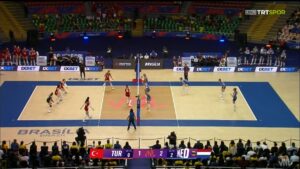
The VNL 2026 match between Turkey and the Netherlands has sparked a broadcast regulation debate in Turkey after courtside LED boards displayed ads for 1xBet, a betting brand that does not hold a legal betting licence in the country.
The match, played in Brasília during the Brazil leg of the Volleyball Nations League, was broadcast in Turkey by TRT Spor and S Sport. The 1xBet branding appeared on the courtside advertising boards as part of the international event feed, rather than as a locally inserted commercial. Still, the appearance of an unlicensed betting brand on Turkish television raises questions about broadcaster responsibility under Turkey’s strict rules on illegal betting promotion.
Ads Came From the International Feed
The 1xBet ads were visible during the live coverage of Turkey’s women’s national volleyball team facing the Netherlands in the VNL 2026 Brazil leg. Based on the available footage, there is no indication that TRT Spor or S Sport inserted the ads into the broadcast themselves.
Instead, the branding appears to have come from the venue’s advertising inventory and was carried through the international broadcast signal. That distinction matters because the Turkish broadcasters were not necessarily selling or placing the advertising locally.
However, it does not fully remove the regulatory issue. Turkish media law focuses not only on who sold the ad, but also on what ultimately reaches viewers in Turkey. Since 1xBet is not among the betting operators legally authorised in the Turkish market, its visibility during a live sports broadcast may still be treated as a sensitive regulatory matter.
The Sponsorship Link With Volleyball World
The source of the 1xBet branding is the company’s global sponsorship agreement with Volleyball World, the commercial entity involved in the promotion, media rights and sponsorship operations of major international volleyball competitions, including the Volleyball Nations League.
In May 2024, 1xBet was announced as Volleyball World’s global betting partner under a five-year deal. The agreement covers major volleyball and beach volleyball events, including the Volleyball Nations League, World Championships, Club World Championships and Beach Pro Tour competitions. As part of the partnership, the brand receives visibility across digital platforms and live events.
That means the courtside ads seen during the Brazil leg were most likely part of Volleyball World’s global sponsorship inventory, not a Turkey-specific advertising arrangement. The problem is that global sports sponsorships do not always align with national betting regulations, and Turkey has particularly strict rules in this area.
Why the Issue Matters in Turkey
Turkey operates a tightly regulated betting market. Betting brands must be authorised under Turkish law, and promotion of unlicensed betting platforms can trigger legal and regulatory consequences.
The debate around the VNL broadcast is therefore not simply about whether TRT Spor or S Sport sold an ad to 1xBet. The more important question is whether Turkish broadcasters can be held responsible when an unlicensed betting brand appears on screen through an international sports feed.
Under Law No. 7258, illegal betting activity and the promotion or encouragement of illegal betting are subject to sanctions. Separately, Law No. 6112, which regulates radio and television broadcasting in Turkey, places responsibility on media service providers for the content they transmit. In past cases, Turkey’s media regulator has interpreted that responsibility broadly, including in relation to sports broadcasts supplied by foreign or international feeds.
Previous RTÜK Decisions Are Important
Turkey’s media regulator, RTÜK, has previously sanctioned broadcasters over unlicensed betting ads visible during sports broadcasts. These precedents are central to the current debate.
In one notable case involving S SPORT+, RTÜK referred to several betting brands, including 1xBet, as unlicensed and illegal betting sites in the Turkish context. The regulator argued that the fact that the content was produced by a third party did not automatically remove the broadcaster’s responsibility. It also indicated that broadcasters should take technical measures where necessary to prevent unlawful advertising from reaching Turkish audiences.
A similar issue arose during TV8’s broadcast of the Montenegro-Turkey football match, where unlicensed betting brands appeared on stadium advertising boards. RTÜK imposed an administrative fine in that case as well. These decisions show that foreign-origin sports feeds can still become a regulatory issue when they carry betting ads that are not permitted in Turkey.
Could TRT Spor and S Sport Face Scrutiny?
There has so far been no publicly announced RTÜK investigation or sanction regarding the VNL 2026 Turkey-Netherlands broadcast. However, given previous decisions, the issue could draw regulatory attention if brought before the authority.
Any potential review would likely consider several factors: how long the 1xBet branding remained visible, how prominent it was on screen, whether the broadcasters had any technical ability to obscure or avoid the ads, and how RTÜK’s existing approach to sports broadcasts applies to this case.
TRT Spor’s status as a public broadcaster adds further sensitivity to the matter, while the same ads appearing on S Sport suggests that the issue is not limited to one channel. More broadly, the case highlights a growing challenge for Turkish broadcasters carrying international sports events: global sponsorship deals may be lawful within the event’s commercial framework, but they can still conflict with local advertising and betting regulations.
For now, the VNL 2026 broadcast has not resulted in a public sanction. Yet the incident has reopened the question of how far Turkish broadcasters are expected to go in filtering or managing international feeds that include betting brands considered illegal in Turkey.