
Lukas Podolski Promotes Illegal Betting in Victory Day Post
By Erdem / 13/08/26
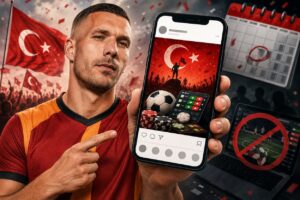
Former Galatasaray forward Lukas Podolski promoted Sekabet, a betting operator that is not authorised to operate in Turkey, in a Victory Day post published on 12 August. The timing drew almost as much attention as the promotion itself, with the message appearing around 18 days before Turkey marks Victory Day on 30 August.
Podolski used the post to recall his time in Turkey, including the supporters and football atmosphere, before tagging Sekabet’s social media account. Given his profile in Turkish football and his large following, the post gave the operator exposure far beyond what its own channels could normally generate.
The relationship is not new. A multi-year brand ambassador agreement between Podolski and Sekabet was announced in November 2024, with promotional content and fan-focused campaigns included in the partnership.
Victory Day holds a special place in my heart 🇹🇷❤️ Turkey gave me unforgettable moments – the fans, the passion, the glory. Proud to celebrate with @Sekaofficialtr_ Zafer Bayramınız kutlu olsun! 🏆 #Sekabet #VictoryDay #Turkey #ZaferBayramı #KazananlarınYeri #AD pic.twitter.com/FycDWByPcH
— Lukas-Podolski.com (@Podolski10) August 12, 2026
Why Was the Victory Day Promotion Posted on 12 August?
Turkey celebrates Victory Day on 30 August, marking the decisive victory in the 1922 Turkish War of Independence. Publishing a Victory Day-themed betting promotion nearly three weeks early therefore immediately made the post stand out.
The timing may simply have been a scheduling error. Another possibility, however, is that the unusual date was a deliberate advertising choice.
Had the same post appeared on 30 August, it would have competed with thousands of other Victory Day messages from athletes, clubs, companies and public figures. Publishing it on 12 August created a different reaction. Instead of simply reading the message, users had an obvious reason to stop, question the date and look more closely at the post.
There is no single established advertising term that precisely describes this tactic. In English, it can broadly be described as a deliberate mistake or intentional error used to attract attention and encourage discussion.
The mechanism also resembles Cunningham’s Law, the internet observation that people are often more motivated to correct incorrect information than to respond to a straightforward statement. A user who sees a Victory Day message on the wrong date may be more likely to comment, repost it or share a screenshot simply to point out the mistake.
An Error Can Turn Into Earned Media
If the timing was intentional, the commercial logic is straightforward: the mistake becomes the story. Once people begin discussing why a 30 August celebration appeared on 12 August, the promotion moves beyond the audience originally reached by Podolski’s post. Screenshots, quote posts, news coverage and online discussion can all expose Sekabet to additional users.
In marketing, this type of additional exposure is known as earned media. Unlike paid advertising, earned media comes from outside attention such as news coverage, social sharing and public discussion rather than media space directly purchased by the advertiser.
A betting promotion that might have passed largely unnoticed on Victory Day can therefore become significantly more visible when published at an unexpected time.
Illegal Betting Brands Keep Finding New Channels
Turkey has intensified action against illegal betting advertising, including blocking social media accounts that promote or direct users to unauthorised gambling platforms.
Blocking a betting website or its own social media account, however, does not necessarily remove the brand from public view. Former footballers, influencers and major sports accounts can provide alternative routes to large audiences.
Recent football-related promotions involving names such as Fabrizio Romano have highlighted the same broader issue. Betting brands that are not authorised in Turkey can still appear alongside transfer news and other football content consumed by millions of Turkish users.
Podolski’s post follows a similar pattern. In this case, a Turkish national holiday was combined with the reach and familiarity of a former Galatasaray player to place Sekabet directly in front of a football audience.
A Stronger Legal Market Remains the Long-Term Answer
Illegal betting operators can lose domains, social media accounts and direct advertising channels while still finding new ways to remain visible. Football sponsorships, former players and global sports personalities give these companies access to audiences that are difficult to shut off completely.
That is why enforcement alone is unlikely to solve the problem. A more competitive legal betting market is also essential.
If licensed operators can offer stronger odds, broader betting markets, better live products, improved technology and a smoother user experience, players have fewer reasons to move toward illegal alternatives.
When users can find the products they want inside a safe, regulated and legal market, one of the strongest advantages held by offshore operators begins to disappear. Otherwise, even when individual sites and accounts are blocked, brands such as Sekabet can continue looking for new ways to re-enter the football conversation.