
Polymarket Blocked in Turkey Over Illegal Betting Concerns
By Erdem / 20/07/26

Turkey has blocked access to prediction market platform Polymarket following a decision by the National Lottery Administration. Users who fund Polymarket transactions through Turkish crypto exchanges could also face administrative penalties if their activity is identified as participation in illegal betting.
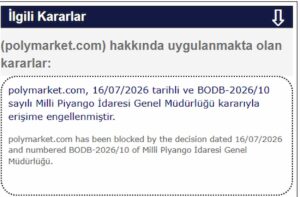
Access to Polymarket.com has been restricted in Turkey under a decision issued by the National Lottery Administration on 16 July 2026.
Polymarket allows users to trade on the outcome of future political, economic, sporting and social events. Although the platform presents these products as prediction-market contracts, Turkish authorities have classified the service as unauthorised betting or gambling, rather than a regulated investment platform.
Why Turkey Classified Polymarket as Illegal Betting
Polymarket users buy “Yes” or “No” positions linked to future events, including elections, economic data releases, sporting results and cryptocurrency prices.
Contracts linked to the correct outcome gain value, while those tied to the wrong result can become worthless. Prices are determined by market participants, but the user’s profit or loss still depends on the outcome of an uncertain future event.
The platform’s technical structure did not change the legal assessment. The decision applies even though:
- Payments are made with crypto assets,
- Orders are matched between users,
- Transactions are settled on a blockchain,
- Products are described as prediction-market or DeFi contracts.
Turkish legislation is not limited to conventional sports betting. It also covers unauthorised games of chance, pool betting and similar activities. The access restriction confirms that Polymarket falls within this broader category in Turkey.
Transfers From Turkish Crypto Exchanges May Be Reviewed
The decision also raises questions about users who fund Polymarket activity through locally regulated crypto platforms.
Buying crypto through Paribu, BtcTurk, Binance TR or another Turkish exchange, and transferring it to a personal wallet, does not by itself constitute illegal betting. The legal risk arises when those assets are used to purchase Polymarket contracts tied to event outcomes.
A transaction trail may include:
- The purchase of USDC or another crypto asset on a Turkish exchange,
- A transfer to a personal or platform-linked wallet,
- Interaction between that wallet and Polymarket contracts,
- The opening of a real-money position on a future event.
The potential penalty therefore relates to participation in unauthorised gambling, not to the crypto transfer alone.
Under Turkish law, people who take part in unauthorised games of chance may face an administrative fine. Users identified as trading on Polymarket could consequently be investigated under illegal gambling provisions.
Blockchain Transactions Are Not Fully Anonymous
Using crypto does not make the activity invisible.
Crypto asset service providers operating in Turkey are subject to customer-identification, record-keeping and transaction-monitoring rules. Transfer records may contain details such as:
- The sender’s verified account,
- The receiving wallet address,
- The asset and amount transferred,
- The date of the transaction,
- Information about the destination wallet or platform.
Polymarket transactions are settled on the Polygon blockchain. This means investigators can potentially trace funds from a regulated Turkish exchange to a wallet and then identify interactions with Polymarket-related smart contracts.
A transfer does not automatically result in a penalty. Authorities would still need to connect the exchange account, the wallet and the Polymarket activity to the same user. However, the assumption that crypto-based betting cannot be traced is increasingly inaccurate.
Intermediaries Face More Serious Penalties
Turkish law distinguishes between users who gamble for themselves and people who facilitate illegal betting for others.
A person using their own funds on Polymarket may face an administrative fine. More serious criminal penalties can apply to those who:
- Collect money from other users,
- Transfer funds on behalf of third parties,
- Operate shared wallets or accounts,
- Provide access to offshore betting services,
- Promote or advertise unauthorised platforms.
Facilitating money transfers connected to illegal betting may lead to imprisonment and judicial fines. Advertising or directing users to such platforms can also trigger separate criminal provisions.
Paribu Suspended Its Polymarket Integration
Paribu announced a Polymarket integration on 1 July 2026. The service was expected to allow users to access selected prediction markets through the Paribu application without opening a separate Polymarket account or using an external wallet interface.
The planned product focused on selected geopolitical, economic and cultural events. However, the feature was disabled shortly after the announcement.
The National Lottery Administration issued its blocking decision roughly two weeks later. There is no official evidence showing that the Paribu integration directly caused the restriction. Nevertheless, the sequence of events demonstrated that presenting prediction markets as DeFi or financial products does not remove them from Turkey’s gambling rules.
The Decision Ends Much of the Legal Uncertainty
The access block did not create a new offence. Turkish law already prohibited unauthorised betting, gambling promotion, payment facilitation and the provision of access to offshore betting services.
The main effect of the decision is that Polymarket has now been formally identified as an illegal betting platform in Turkey.
Users who purchase crypto through Turkish exchanges and later use those assets on Polymarket may therefore face administrative penalties if the activity is detected and linked to them. Routing funds through a personal wallet, using stablecoins or describing the service as a prediction market does not remove that legal risk.