
Legal Betting Sites Face Promo Ban As Advertising Rules Tighten In Turkey
By Erdem / 13/02/26
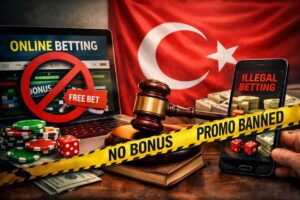 A regulatory change published in Turkey’s Official Gazette on February 13, 2026 is reshaping how licensed online betting operators can market themselves. Widely described in local media as a “promotion ban,” the update does not impose a blanket advertising prohibition. Instead, it removes the previous “sales-boosting” logic from the framework and replaces it with a narrower, more controlled approach centered on public interest, responsible gambling, and supporting the fight against illegal betting.
The change applies to fixed-odds and pool betting products operated under the authority of the Spor Toto Organization and is expected to affect how licensed “online dealers” communicate bonuses, incentives, and campaigns.
Which Regulation Introduced The Promotion Restrictions
The update amends Article 31(1)(e) of the “Implementation Regulation on Fixed-Odds and Pool Betting Based on Sports Competitions.” It entered into force on the date of publication, meaning the new standards are immediately relevant for ongoing and future marketing activity.
What makes this amendment significant is what it removes. Earlier wording explicitly referred to increasing total sales and allowed incentive-driven promotions under certain conditions. The revised text shifts the emphasis away from sales growth and toward regulated communications designed to keep players within a supervised environment.
In practical terms, the move is being interpreted as a major limitation on bonus-style promotions—such as sign-up offers, free bets, rewards, or similar incentives—when they are used primarily as tools to boost turnover.
What The New Advertising Rules Actually Require
Under the updated wording, marketing and promotional communications must comply with three core conditions:
-
They must not encourage or target anyone under the age of 18
-
They must not undermine social values or public sensitivities
-
They must be limited to sports-related media channels
That “sports-related media” requirement is the most consequential from a market perspective. It narrows not only what can be said, but also where it can be said. Sports TV programming, sports news environments, and sports-focused digital placements are likely to remain within scope, while broader entertainment media, youth-heavy channels, or general-purpose influencer marketing may face tighter scrutiny.
The regulation also frames these communications as part of a broader objective: supporting action against illegal betting, promoting a safer, supervised playing environment, and increasing public benefit. That language signals a clear policy direction: marketing is no longer treated primarily as a commercial growth lever, but as a tool to reinforce the licensed system.
How The Promo Ban Could Affect The Legal Betting Market
For consumers, the most visible impact is likely to be a simplified campaign landscape. Licensed operators may reduce the variety and intensity of bonus offers, and overall messaging may lean more heavily on responsible play and “safe platform” narratives rather than aggressive acquisition tactics.
In the short term, the market may see:
-
Fewer headline-grabbing bonus campaigns
-
More standardized offers, if any, under tighter compliance controls
-
A shift toward informational messaging rather than incentive-heavy ads
However, the most debated issue is whether limiting promotions in the legal market will meaningfully reduce illegal betting—or unintentionally create side effects.
Could Illegal Betting Platforms Become More Attractive
A key risk raised by analysts is that if legal operators lose the ability to compete through promotions and wide-reach marketing, illegal betting sites may become comparatively more appealing. Unlicensed platforms typically rely on aggressive incentives and high-odds messaging, and they operate outside the same compliance boundaries.
If enforcement against illegal betting does not strengthen in parallel, restricting legal marketing could:
-
Reduce the visibility of licensed options
-
Push deal-seeking players toward unregulated sites
-
Increase the relative “noise” created by illegal operators in digital channels
This is why implementation matters as much as the written text. The impact will depend heavily on two factors: effective enforcement (including blocking and financial disruption mechanisms) and public awareness that distinguishes licensed services from illegal operations.
A Long-Term Debate: Controlled Competition Versus Tight Restrictions
Beyond the immediate compliance changes, the regulation has reignited a broader policy debate: how to reduce illegal betting sustainably. Some industry voices argue that restrictions alone rarely eliminate black markets. They claim that a long-term solution would require a more competitive but tightly regulated market structure, where multiple licensed operators can offer compelling products under clear rules, generating tax revenue while keeping players inside the legal ecosystem.
Under this view, a controlled market with transparent promotional standards could:
-
Improve consumer choice within legal channels
-
Reduce the incentive to migrate to illegal platforms
-
Increase accountability and responsible gambling protections
-
Strengthen tax collection and oversight
Critics of heavy restrictions argue that if the legal market becomes too limited—especially on promotions and reach—players may be more likely to explore offshore alternatives, making enforcement harder and risks higher.
Turkey’s new rules are a meaningful pivot in how legal betting can be marketed: less sales-driven promotion, tighter placement rules, and a clearer public-interest narrative. Whether the “promo ban” helps curb illegal betting will ultimately depend on enforcement capacity and how effectively licensed operators can remain visible and attractive within the new, sports-media-limited framework.
Hello to all, how is the whole thing, I think every one is getting more
from this web site, and your views are nice for new people.