
Illegal Betting Probe In Türkiye: Tuzlaspor-Linked Case Expands, Diyarbekirspor Placed Under State Control
By Erdem / 17/02/26
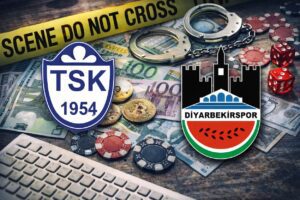 New details have emerged in an illegal betting investigation in Türkiye that names Tuzlaspor and Diyarbekirspor and has now widened into a major financial probe. The case is being coordinated by the Istanbul Anatolian Chief Public Prosecutor’s Office, which is examining allegations that proceeds generated from illegal betting were funneled into the legal economy through money laundering schemes.
Alongside detentions, authorities have moved to secure assets connected to the investigation. The file is described as heavily evidence-driven, relying on financial tracking and digital forensics, including reports and analyses that map money flows across accounts and platforms.
Two names are repeatedly referenced in the publicly reported part of the investigation. On the Diyarbekirspor side, former club president Fevzi İlhanlı is cited in connection with the allegations. On the Tuzlaspor side, former club president Recep Doğrul is also mentioned. Prosecutors are focusing less on sporting matters and more on whether club structures and related entities were used as conduits for disputed funds.
The Investigation Focuses On Illegal Betting And Money Laundering
The case centers on two alleged offenses: illegal betting activity and laundering the proceeds of crime. Prosecutors are examining claims that funds believed to originate from illegal betting were moved through multiple channels to create the appearance of legitimate income.
According to information reflected in reporting on the investigation, the file includes oversight findings, a report by MASAK (Türkiye’s Financial Crimes Investigation Board), cybercrime analyses, and assessments tied to crypto-asset movements. These elements indicate the inquiry is not limited to identifying the betting activity itself, but is equally focused on where the money came from, how it moved, and where it ultimately ended up.
Coordinated Raids In Five Provinces: 10 Detained, 5 Sought
Authorities carried out an operation centered in Istanbul, extending to Ankara, İzmir, Hatay, and Diyarbakır. In the latest official figures reflected in reporting, 10 suspects were detained, while five others were reported to be at large, with efforts continuing to locate them.
The multi-province scope suggests investigators are treating the suspected financial network as broader than a single local group, and are working to reconstruct a money trail that spans different regions.
Asset Seizures Expanded To Companies, Vehicles, And Real Estate
One of the most striking aspects of the operation has been the scale of asset seizures. Publicly reported details indicate authorities imposed measures including:
-
Seizure of 3 companies
-
Intervention in 1 football club through a trustee/administrator process
-
Seizure of 6 vehicles and 3 motorcycles
-
Seizure of 7 apartments, 6 parcels of land, and 1 commercial property
-
Collection of a large volume of digital devices and materials for forensic review
The breadth of the seizure list underscores that the investigation is not confined to individual suspects. It also targets what authorities describe as the corporate and asset-holding layer of the alleged financial scheme—an approach typically associated with money laundering investigations.
The “Club Track” Of The Case: State Intervention At Diyarbekirspor, Tuzlaspor Under Review
The investigation’s football dimension is unfolding on two separate but connected tracks.
First, Diyarbekirspor became the most visible institutional focus after authorities applied seizure measures and initiated a trustee/administrator process for the club. In practical terms, this indicates the state is treating the club as potentially integral to the suspected financial flow, rather than as a peripheral detail.
Second, Tuzlaspor is being examined primarily through the lens of alleged financial activity around the club and its associated circles. Reporting on the file notes that former Tuzlaspor president Recep Doğrul is mentioned in that context. On the Diyarbekirspor side, former president Fevzi İlhanlı is the name most frequently highlighted. The emphasis, however, remains on the mechanics of the money trail and how football entities may have been positioned within it.
How The Money Was Allegedly Moved: Layered Accounts And Digital Footprints
At the core of the case is the question of method: how the disputed proceeds were allegedly transferred and disguised.
The investigation narrative described in reporting suggests that the funds were not deposited into club accounts in a single, direct step. Instead, they were allegedly routed through intermediary accounts to reduce traceability. Key allegations include:
-
Use of accounts linked to the club’s financial administration—including individuals working in or around club accounting—as intermediary channels
-
Deployment of third-party bank accounts for a fee, a practice often described as “IBAN renting” or the use of “money mules”
-
Intensive transfers across multiple bank accounts within short time frames
-
Review of a wide pool of accounts tied to digital payment systems, alongside broader digital evidence collection
Investigators are expected to rely heavily on seized digital materials to clarify the origin, routing, and final destination of funds. The involvement of cybercrime analysis and financial reporting indicates that the case is being pursued as much as a forensic accounting exercise as a policing operation.
Tuzlaspor’s Name Change Background: The Beykoz Anadolu Spor A.Ş. Detail
A secondary point in the public discussion has been Tuzlaspor’s corporate and naming history. Following a transfer process in 2024, Tuzlaspor has been referenced in some contexts as Beykoz Anadolu Spor A.Ş.. In the investigation itself, however, reporting indicates the club is referenced under the name Tuzlaspor, reflecting the period in which the alleged conduct is said to have occurred.
For foreign readers, this is a common complication in sports governance: a club’s competition identity and its corporate structure or registered entity can shift over time, while legal files often anchor references to the name used during the alleged events.
Earlier Public Allegations Resurface: Ticketing Questions And Betting-Market Suspicion
The investigation has also revived earlier public debate around Tuzlaspor. Journalist Murat Ağırel previously wrote about issues including unusually high ticket prices and questions around ticketing data versus stadium attendance.
For context, Passolig is Türkiye’s centralized electronic ticketing system used for many football matches. Earlier commentary pointed to apparent inconsistencies—tickets appearing as sold in the system while stands looked sparsely populated—alongside claims that certain matches drew unusual attention in betting markets.
The current investigation does not, by itself, establish those earlier claims as proven. But the renewed focus highlights why the intersection of club finance, ticketing, and betting-market activity remains sensitive and closely watched.
What Investigators Are Likely To Focus On Next
Two lines of inquiry are expected to shape the next stage:
-
Identifying the funds’ origin, the intermediary-account chain, and the final destination
-
Determining whether club revenues were allegedly presented under legitimate labels—such as sponsorships, ticketing, or other income streams—to mask the origin of the money
As authorities continue efforts to locate the five suspects reportedly still at large, the results of financial analyses and digital forensic work are likely to determine whether the investigation expands further and whether additional seizure measures are pursued.
just wow…