
Premier League Heads Into New Season With Front-of-Shirt Gambling Sponsorship Ban
By Erdem / 29/07/26
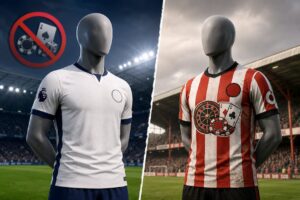
The 2026/27 Premier League season begins on 21 August. For the first time, clubs will not be allowed to use gambling companies as their main front-of-shirt sponsors, while no equivalent restriction applies in the lower divisions. The reasons behind the decision and its likely effects remain open to debate.
Gambling sponsorship agreements have attracted growing attention in the Premier League in recent years. The period that began with Fulham’s Betfair deal in 2002/03 continued through the end of the 2025/26 campaign. The new season will start without gambling brands on the front of Premier League shirts. However, this is not a nationwide legal ban. It is a voluntary collective agreement adopted by Premier League clubs and applies only to the front of matchday shirts.
How Gambling Advertising Became Embedded in English Football
Gambling advertising did not become a major part of English football overnight. Licensed betting shops, the liberalisation of television advertising and the growth of online gambling gradually turned betting brands into permanent commercial partners. A short timeline shows how the current position developed.
- 1961: Licensed betting shops began operating following the Betting and Gaming Act 1960. This brought a large part of off-course betting into a licensed and far more visible commercial system.
- 1994: The launch of the National Lottery made gambling products a more familiar part of mainstream television. Sports betting and online casino operators still did not have broad access to television advertising at this stage.
- 2002/03: Fulham’s agreement with Betfair is widely regarded as the first Premier League front-of-shirt sponsorship by a betting company. Gambling brands therefore gained exposure through football broadcasts before wider television advertising was permitted.
- 2007: The Gambling Act 2005 came fully into force, allowing licensed gambling operators to advertise on television, radio and other media. The treatment of sports betting around live broadcasts further strengthened the relationship between football and gambling marketing.
- 2014: Overseas operators serving customers in Great Britain were required to obtain a Gambling Commission licence. Free-bet campaigns, mobile apps, shirt sponsorships, digital marketing and stadium advertising became central parts of the industry’s promotional model.
- 2019: Gambling companies introduced the “whistle-to-whistle” restriction on television adverts around live sport shown before 9pm. The measure did not cover shirt logos, pitchside LED boards or digital advertising.
- 2022: New advertising rules made it harder to use footballers, athletes, influencers and other figures with strong appeal to children and young people in gambling campaigns.
- 2023: Premier League clubs collectively agreed to remove gambling companies from the main sponsor position on the front of matchday shirts. Existing deals were allowed to continue until the end of the 2025/26 season.
- 2026/27: Around 24 seasons of front-of-shirt gambling sponsorship in the Premier League come to an end. Betting brands can still appear on sleeves, training wear, LED boards, digital platforms and the shirts of lower-league clubs.
Why Is Front-of-Shirt Gambling Sponsorship Being Removed Now?
Premier League clubs announced in April 2023 that gambling companies would be removed from the main front-of-shirt sponsorship position from the 2026/27 season. The agreement covers only the Premier League and only one part of the matchday shirt.
The central argument is that front-of-shirt gambling logos create particularly strong exposure among children and people at risk of gambling-related harm. The branding is not limited to the 90 minutes of a match. It also appears in club photography, retail shirts, video games, collectable cards and promotional material used throughout the season.
This reasoning is understandable. Reducing gambling visibility can be valuable for both children and vulnerable adults. However, the decision also creates several inconsistencies.
Gambling brands removed from the shirt front can move to the sleeve or remain on training wear. There is also no equivalent restriction on pitchside LED boards or many digital partnerships. As a result, overall visibility may not fall as sharply as the shirt-front change suggests.
Which Companies Replaced Gambling Sponsors?
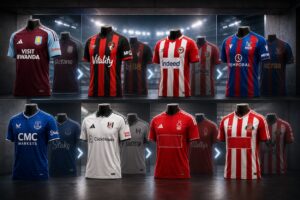
In 2025/26, 11 of the Premier League’s 20 clubs had a betting or casino brand on the front of their shirts. Some were relegated, while the clubs that remained in the division had to find replacements. As of 29 July 2026, the confirmed changes included:
- Aston Villa: Betano to Visit Rwanda
Aston Villa replaced Betano, which had occupied the front of the shirt for two seasons, with the tourism brand Visit Rwanda. The logo will appear on the shirts of the men’s, women’s and academy teams. Betano has not left the club and will instead appear on the left sleeve under a new three-year extension. - AFC Bournemouth: bj88 to Vitality
The bj88 logo on Bournemouth’s 2025/26 shirts was replaced by Vitality, the health and life insurance brand that already held the naming rights to the club’s stadium. Bournemouth also agreed a sleeve partnership with online casino brand MrQ. - Brentford: Hollywoodbets to Indeed
Brentford replaced Hollywoodbets, which had appeared on the shirt throughout the club’s Premier League period, with recruitment platform Indeed. Indeed had already featured on the club’s training wear and will now sponsor the shirts of the men’s, women’s and academy teams. - Crystal Palace: NET88 to Temporal
Crystal Palace’s two-season partnership with NET88 ended, with technology company Temporal taking over the front-of-shirt position under a multi-year agreement. - Everton: Stake to CMC Markets
Everton replaced Stake, its front-of-shirt partner since 2022/23, with financial services company CMC Markets. Stake remains involved as the club’s sleeve partner, moving the gambling logo from the front of the shirt to a smaller area. - Fulham: SBOTOP to ClickHouse
After three seasons with SBOTOP on the front of the shirt, Fulham appointed real-time analytics and data infrastructure company ClickHouse as principal partner and men’s first-team front-of-shirt sponsor.
Clubs Yet to Announce a New Sponsor
- Nottingham Forest: Bally’s to Sponsor Not Yet Announced
Nottingham Forest worked with casino and entertainment company Bally’s in 2025/26. Its 2026/27 home shirt was launched without a new main sponsor, and no replacement had been announced by 29 July. - Sunderland: W88 to Sponsor Not Yet Announced
W88 appeared on the front of Sunderland’s shirts during the club’s 2025/26 Premier League campaign. Sunderland also launched its 2026/27 home shirt without front-of-shirt branding, with no replacement announced by 29 July.
The available deals show that the space left by gambling operators is being filled mainly by companies from the finance, technology, insurance and tourism sectors. Betting brands have not disappeared from English football, however. Betano and Stake moved to shirt sleeves, while Bournemouth added a new gambling sleeve sponsor. The policy therefore changes the most prominent part of the shirt without ending the commercial relationship.
Why Does the Ban Not Apply to England’s Lower Divisions?
One of the clearest inconsistencies is that no equivalent restriction applies in the EFL. Premier League clubs cannot place gambling companies on the front of their shirts, while clubs in the Championship, League One and League Two remain free to do so.
The main reason is structural. The rule is a voluntary Premier League agreement rather than a nationwide law, so it does not bind EFL clubs. Economics also matter. Premier League clubs generally receive far greater broadcasting and international commercial income, whereas lower-league clubs can be more dependent on sponsorship revenue. The EFL itself has a title partnership with Sky Bet until the end of the 2028/29 season.
This weakens the responsible-gambling logic behind the restriction. Children who support or watch lower-league clubs will continue to see the same brands on shirt fronts. Promotion and relegation also make long-term planning more complicated, because a sponsorship position that is permitted in the Championship becomes unavailable if the club reaches the Premier League.
The Birmingham City-Coral agreement is a current example. Coral will appear on the men’s and women’s shirts during the 2026/27 Championship season. If Birmingham are promoted, Coral cannot remain on the front of the club’s Premier League shirts. The wider partnership, which runs beyond that season, would not necessarily have to end and could continue through different advertising or sponsorship rights.
Will the Front-of-Shirt Ban Have a Meaningful Effect?
It would be wrong to describe the removal of front-of-shirt gambling sponsorship as a wholly negative step. Reducing visibility can help protect children and people vulnerable to gambling-related harm. However, the limited scope of the agreement and the absence of an equivalent rule in the EFL suggest that it is unlikely to produce a dramatic reduction on its own.
In 2025, the University of Bristol examined the opening weekend of the Premier League across live match broadcasts, Sky Sports News, TalkSport and social media. Researchers recorded 27,440 gambling messages. Only around 9.6% of the gambling messages seen during live broadcasts appeared on the front of shirts, with most exposure coming from pitchside boards, broadcasts, stadium advertising and digital content.
The research suggests that the front-of-shirt restriction may remain partly symbolic. The Premier League will begin a season without gambling brands in its most prominent shirt position for the first time in around 24 years, but those companies are not leaving English football. They are moving to sleeves, LED boards, digital partnerships and lower-league shirts. The real impact will become clearer when gambling exposure during the 2026/27 season can be compared with previous campaigns.